
Decolonising visuality: Introduction

Authors

DOI:

https://doi.org/10.34619/araa-bqbh

Abstract

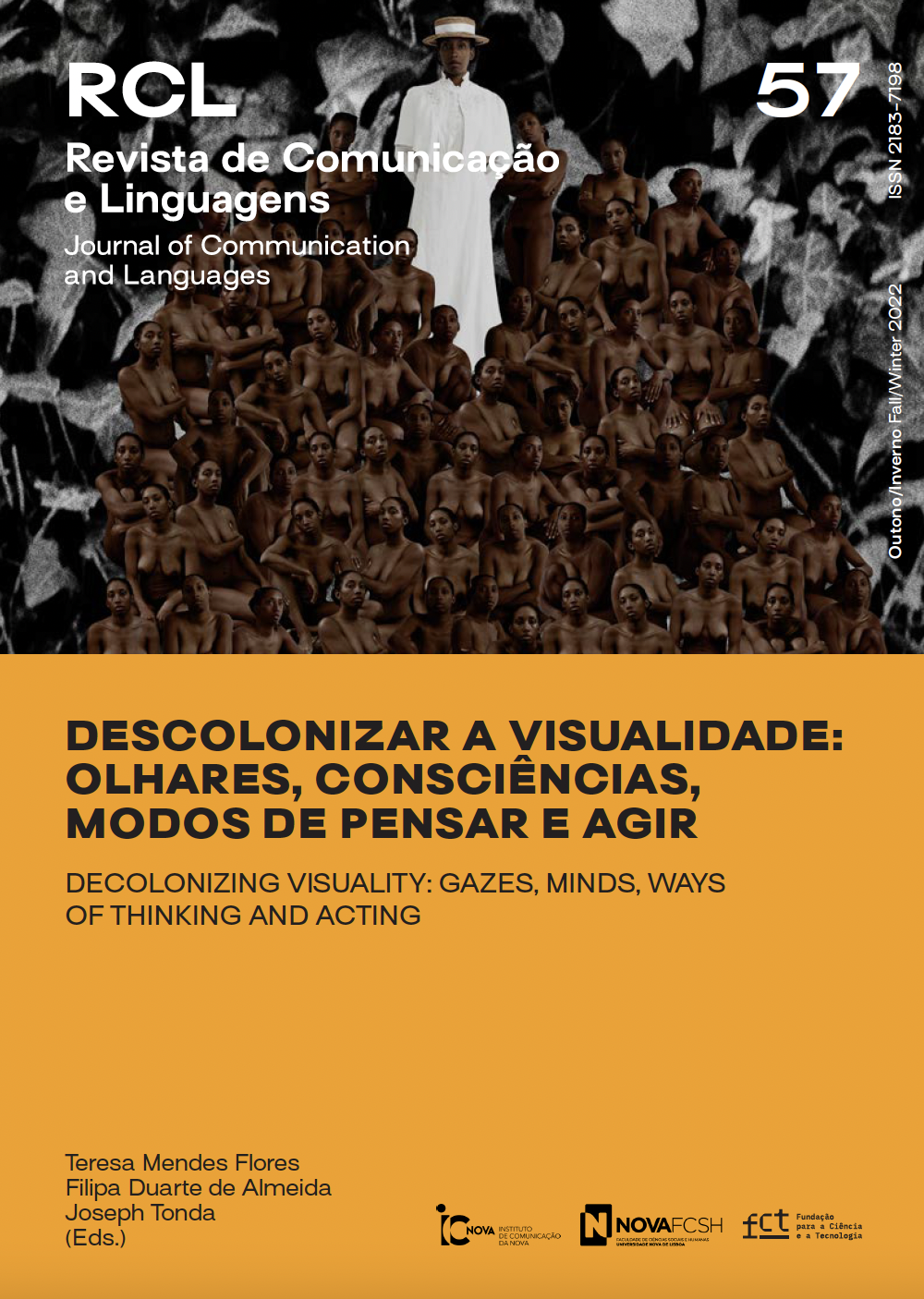
This edition of the RCL proposes a reflection on the decolonisation of visuality, to which we have added the words "gazes, consciousnesses, ways of thinking and acting" to point out the range of meaning that the term visuality proposes, noting the links that are established between external images and internal mental images, between thoughts and actions, between perceptions
and representations and the role played by images in the processes of acculturation and internalisation of social norms. In short: to point out the role of visuality formed in the constitution of subjectivities and forms of sociability, which are also forms of expression of alternative subjectivities, participating in social changes.
The world where the colonised territories were formally emancipated and liberated is the same world where many of their legacies endure in the various forms of social and environmental oppression we experience today, despite the many improvements achieved in democratic societies.
The space of visuality created by colonialism functions as a dreamlike space composed of mental images that show what is not visible in reality. Images and words, through their specificities, were and are used as legitimising forces of forms of power that oppress and crystallise representations about entire communities or people who have had their image and words stripped from them. This issue focuses on understanding and interrogating these processes, rooted in historical colonialism. To do so is also to defend democracy and social and environmental justice. This edition means to contribute to these values when we commemorate almost 50 years of the democratic process in Portugal (which took place on 25th April 1974).
Author Biographies

Teresa Mendes Flores, ICNOVA, Faculdade de Ciências Sociais e Humanas da Universidade Nova de Lisboa. Universidade Lusófona, Portugal

Photography and film historian and researcher in media archaeology, visual culture and semiotics. D. in Communication Sciences from Universidade Nova de Lisboa (2010), she is a researcher at ICNOVA and Assistant Professor at the Department of Communication Sciences at Universidade Lusófona. She has published the books Cinema and Modern Experience (Minerva Coimbra, 2007), Photography and Cinema. Fifty Years of Chris Marker’s La Jetée (Cambridge Schollars, 2015), Politics in the Feminine (Aletheia 2016) and Images&Archives. Photographs and Films (ICNOVA Books, 2021), in addition to several book chapters and articles. She was the principal investigator of the research project “The photographic impulse: measuring colonies and colonised bodies. The photographic and filmic archive of the Portuguese missions of geography and anthropology.” (PTDC/COM-OUT/29608/2017), funded by the Foundation for Science and Technology, and one of the curators of the exhibition “The photographic impulse. (Un)tidying the colonial archive” (on view at the Museum of Natural History and Science in Lisbon). Co-director of the Journal of Communication and Languages, she was, until recently, coordinator of the Research Group Culture,Mediation&Arts at ICNOVA. Currently, she integrates the team of the projects Curiositas: Peeping Before Virtual Reality. A Media Archaeology of Immersion Through VR and the Iberian Cosmoramas (PTDC/ COM-OUT/4851/2021) and ‘Decolonising the Panorama of Congo: A Virtual Heritage Artistic Research’ (H2020). Her interests include gender and visual culture, archaeology of optical and immersive media, photography in colonial contexts, and postcolonial and memory studies. 

Filipa Maia Duarte de Almeida, Professora-investigadora de Antropologia Africana do departamento de Antropologia da Universidade Omar Bongo, Libreville

Filipa Maia Duarte de Almeida was born in Lisbon in 1969. She has a degree in Industrial Design from the Faculty of Design, Technology and Communication (IADE), a Masters in the History of Africa from the Faculty of Letters of the University of Lisbon, and a PhD in Anthropology, specialising in African Religions, from the University Omar Bongo (Libreville-Gabon). Lecturer at the Anthropology Department of the Omar Bongo University, responsible for the Master’s Degree course in Sensitive Anthropology. Member of the Research Group Corps, Societé et Pouvoir, and of the Séminaire Interdisciplinaire des Études et Recherches Africaines, where she has coordinated and/or participated in various research projects, seminars and colloquia, including the International Colloquium “Le sexe postcolonial en Afrique Centrale et Ailleurs”, held in April 2022. Author of several articles and speaker at various seminars, conferences and colloquia. 

Joseph Tonda, Professor Catedrático de Sociologia e Antropologia, Director da Formação Doctoral da Universidade Omar Bongo, Libreville

Joseph Tonda, of Congolese/Gabonese nationality, was born in Mekambo (Gabon). He grew up and studied in the Republic of Congo and completed his university studies in France. He is currently Full Professor of Anthropology and Sociology at the Omar Bongo University (Libreville, Gabon). He is regularly invited by the Ecole des Hautes Etudes en Sciences Sociales (Paris) and several international universities (USA, South America, Europe and Asia) as a lecturer and seminarian. Author of La guerrison divine en Afrique Centrale (2002, Paris Karthala), Le Souverain Moderne. Le corps du pouvoir en Afrique Centrale (2005, Paris, Karthala), L’Impérialisme postcolonial. Critique de la société des éblouissements (2015, Paris, Karthala), and Afrodysthopie. La vie dans le rêve d’Autrui (2021, Paris, Karthala), Joseph Tonda focuses mainly on social power relations and forms of cultural and religious expression in Central African societies. He was ranked by New African magazine among the 50 most relevant contemporary African intellectuals. He is the author of the novels Chiens de Foudre and Tuée-tuée mon amour

Published

2022-12-30

How to Cite

Mendes Flores, T., Almeida, F. M. D. de, & Tonda, J. (2022). Decolonising visuality: Introduction. Revista De Comunicação E Linguagens, (57), 9–26 / 27. https://doi.org/10.34619/araa-bqbh