Ainda
DOI:
https://doi.org/10.34619/31ug-hwkeKeywords:
litterature, cinema, drift, rephotographyAbstract
The starting point of Still is Bruges-La-Morte, a novel written by Georges Rodenbach in 1892, in which Hugues Viane moves to the city after becoming a widower, and there he encounters a woman identical to his beloved one (the dead dies a second time - a premise of the myth of Orpheus and Eurydice ). It is considered the oldest book to use photography as part of its narrative.
Thirty-one photos of the city, taken between 1888 and 1890 by the Parisian studios of Levy & Neurdein, are included in the first edition by Flammarion. Introduced by Rodenbach in a note to the reader, “they are not merely backdrops or arbitrarily chosen descriptive themes, but rather are genuinely connected to the action of the book” (Rodenbach, 1898, 3).
Bruges-la-Morte inspired adaptations and remakes. Opera: Die Tote Stadt by Korngold (1932). Cinema: adapted as Rêves by Yevgeni Bauer (1915), Mas Allá del Olvido by Hugo del Carril (1956), and also the homonymous films by Alain d'Henáut (1980), Ronald Chase (1978), and Rolland Verhavert (1981). In 1954, Boileau and Narcejac produced a literary remake, D’entre les morts, which Alfred Hitchcock used as the basis for Vertigo (1958). In 1962, Chris Marker premiered La Jetée, later stating its film was a no less than a Vertigo remake (Burgin 2004, 89).
Bruges-la-Morte becomes a precursor to a subgenre — followed, among others, by Sebald, Breton, Calle, and Blaufuks — that explores the text-image relationship as a holistic entity, close to what Roland Barthes refers to as the third meaning. After the obvious and symbolic levels, it is obtuse, like an angle greater than the right-angle, that, beyond language, cannot be described but only observed (Barthes 1990, 45-61).
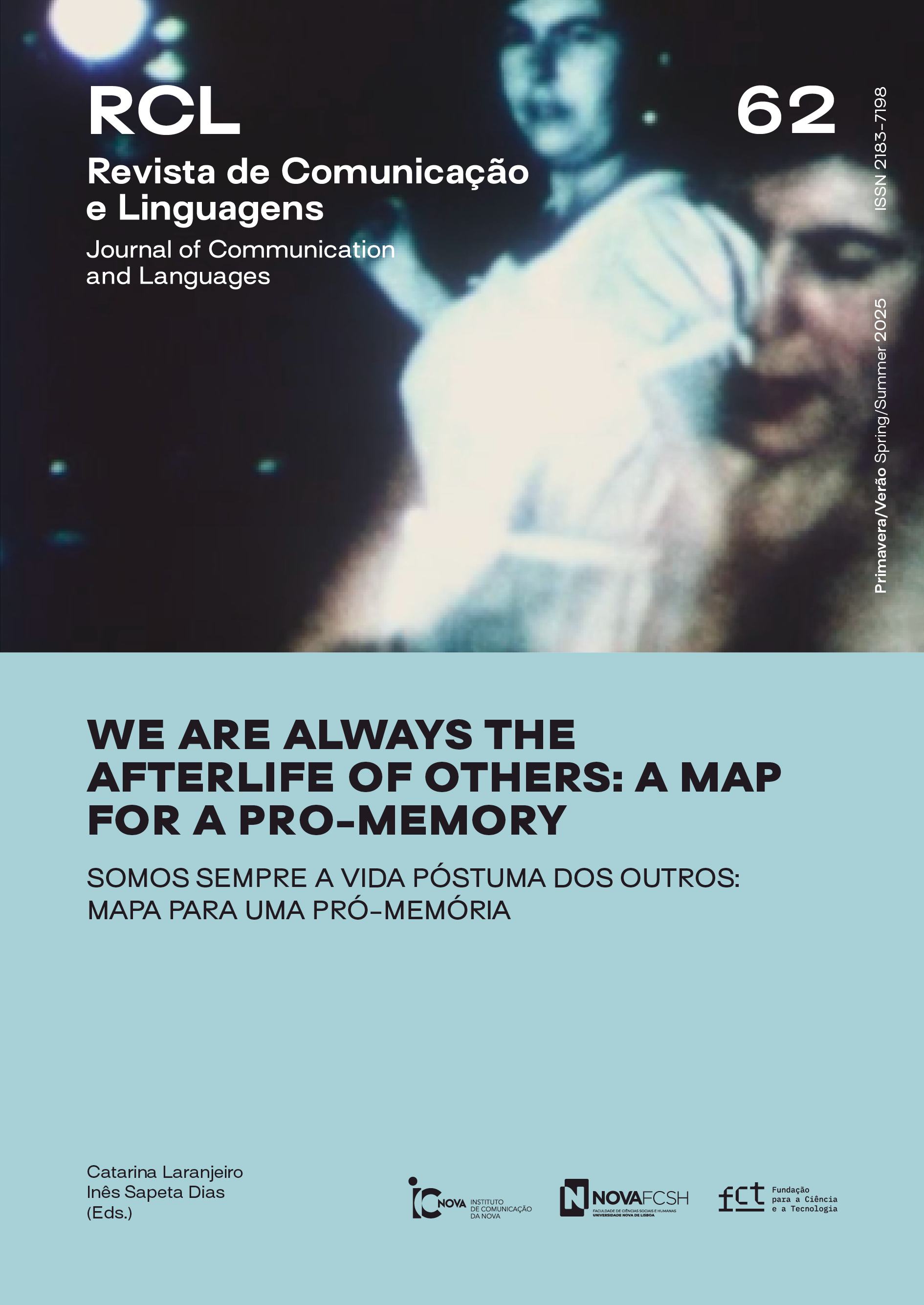
My personal memory for this series was made up from a plethora of influences and reminiscences from travels and time spent in Bruges, shaped by the book and its resonances. The images that constitute this series are Instax prints made from photographs by the author and frames from the aforementioned films Vertigo, La Jetée, and Rêves.
Downloads
Published
How to Cite
Issue
Section
License
Copyright (c) 2025 Eduardo Brito

This work is licensed under a Creative Commons Attribution-NonCommercial 4.0 International License.